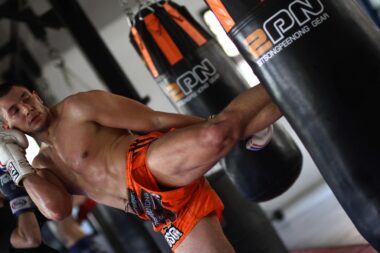

Understanding the Fight Stance in Muay Thai
One of the crucial components of Muay Thai is the fight stance, which serves as the foundation for successful techniques and strategies. A proper stance allows practitioners to maintain balance, generate power, and quickly execute strikes or defensive maneuvers. Muay Thai stances differ slightly between fighters, often depending on personal preference, body type, and fighting style. However, there are standard principles that can enhance effectiveness. For example, the feet should be positioned shoulder-width apart, providing optimal stability during movements. Weight distribution must be appropriate, with a slight lean forward to prepare for attacks or counterattacks. In addition, it’s essential to keep your hands up to protect the face and open body. Learning to shift weight effectively between stances can also make a significant difference, allowing for swift directional changes. Ultimately, mastering the fight stance is key to becoming proficient in Muay Thai, as it lays the groundwork for executing various techniques and responding to opponents’ actions. This understanding will provide you with a solid base for further training and skill development as you advance in your Muay Thai journey.
In Muay Thai, the fight stance emphasizes the importance of guard and balance. To begin with, fighters should keep their elbows close to the body to protect the ribs and minimize openings for opponents. The chin should be tucked down slightly, presenting a smaller target for strikes. A common misconception is that you should lean back when defending, but this often leads to vulnerabilities in striking. Instead, effective footwork and leg positioning are instrumental in maintaining a low center of gravity while allowing for agility. Moreover, incorporating head movement can reduce the chances of getting struck while maintaining an optimal stance. This combination not only enhances defense but also creates opportunities for counters. Regular drills and sparring sessions focused on stance cultivation are essential for refining these skills. Fine-tuning balance must not be ignored, as even slight adjustments can provide significant advantages. Overall, a well-practiced stance makes all the difference, standing as the first line of defense while enabling fluid transitions to offensive maneuvers. In doing so, fighters will feel more confident during training and competition, thus obtaining improved performance and mastery in the sport.
The Role of Footwork in Fight Stance
Footwork plays an integral role in Muay Thai, significantly influencing the effectiveness of the fight stance. A solid fight stance provides the framework to implement dynamic footwork techniques. The objective is to maintain mobility while remaining balanced and prepared for strikes. Fighters should practice shifting their weight seamlessly between their feet, allowing them to evade attacks and reposition themselves as needed. Adding lateral movements into practice can enhance the understanding of angles while maintaining the groundwork of the stance. Pivoting and stepping back or forward are also crucial aspects. Practicing foot drills can establish muscle memory, making transitions feel natural during bouts. Moreover, petting the distance to gauge opponents’ reach requires significant footwork proficiency. For example, advancing with precise footwork allows the creation of openings for delivering kicks or punches efficiently. On the other hand, retreating effectively is also critical when evading a flurry of blows. Understanding how to control the distance increases a fighter’s ability to dictate the pace of the match, which is vital for a successful outcome. Hence, comprehensive training in footwork within the context of the fight stance is essential for any aspiring Muay Thai fighter.
Another vital aspect to consider in the fight stance is the alignment of the body. Proper alignment not only enhances balance but also maximizes striking power. When positioned correctly, your stance allows energy from your legs and core to flow into every strike, increasing effectiveness. A common mistake for beginners is to position their shoulders too far forward or backward, which can hinder the overall functionality of the stance. Ideally, shoulders should remain relaxed but equally engaged. The alignment extends from your feet through your torso up to the head. When strikes are executed, a unified body alignment will help ensure powerful, well-coordinated movements. Additionally, understanding body alignment aids in developing a more effective guard. Keeping your hands and elbows aligned with your hips ensures that defensively engaged actions remain responsive and quick. Relying on strength is not the answer; rather it’s rooted in technical understanding and practice. Positioning your body correctly leads to a better sense of control whether attacking or defending. As mastering fighting alignment can greatly impact performance, continuous focus on these details is crucial as you advance through your Muay Thai training.
Striking Techniques from the Fight Stance
The fight stance in Muay Thai opens the door to a variety of striking techniques that can be effectively executed. Understanding how to transition seamlessly from your stance into strikes is vital for maximizing your offense. For example, using a balanced stance allows for powerful kicks, whether they are low, middle, or high. Proper weight distribution will assist in generating momentum to deliver forceful strikes. Additionally, the angle of the hips plays a vital role in generating power for elbow strikes, knee strikes, and punches. Practicing these techniques from the stance builds confidence and ability. Various combinations also thrive when initiated from a strategic fight stance. For instance, one might employ a jab to gauge distance followed by a strong roundhouse kick. Seamlessly chaining strikes can bewilder the opponent while maintaining effectiveness. It’s crucial to recognize that a solid stance serves as a launching pad for your attacks. Thus, sufficient drills emphasizing the core transitions from your stance to strikes will sharpen your overall fighting prowess. Continuous practice enables quick, fluid movements during sparring and combat scenarios, ultimately leading to greater proficiency in the Muay Thai discipline.
A key component of mastering the fight stance is the recognition of when and how to shift between offensive and defensive positions. As each bout evolves, the ability to adapt is essential for achieving victory. While maintaining a fundamental stance is vital, fighters must recognize moments that call for either a more aggressive stance or a more defensive one. For example, when an opponent is on attack, a retreat or defensive stance may be more beneficial. Conversely, upon either countering or gaining the initiative, transitioning back into an offensive stance will allow for swift responses. Learning to read opponents and adjusting your stance accordingly can significantly provide leverage during combat. Regularly practicing drills that focus on shifting stances while maintaining form will also improve reaction times and adaptability. Sparring can particularly benefit fighters by providing real-time feedback on their stance adjustments. Ultimately, understanding the dynamics between offense and defense leads to enhanced control during matches. As fighters invest time into refining these skills, they will evolve as more strategic competitors in the ring, showcasing exceptional adaptability and technical proficiency moving forward.
Conclusion: Mastering the Fight Stance
Ultimately, mastering the fight stance in Muay Thai is a vital aspect that all fighters must prioritize. Through understanding the mechanics of stance, fighters can establish a solid foundation for executing a wide array of techniques. Importantly, recognizing how elements such as balance, body alignment, and footwork contribute to an effective stance cannot be overstated. Whether you’re striking or defending, a well-cultivated stance provides the advantage needed to control your performance throughout the fight. Regularly practicing adjustments in stances creates muscle memory, enhancing your capabilities when engaging opponents. Additionally, as techniques are integrated into the stance, fighters develop the ability to fluidly transition between offensive and defensive modes. With time, dedication, and commitment, the fight stance becomes second nature, allowing for effective response and planned sequences. Therefore, consistent training and engagement with coaches will help refine and elevate performance. In conclusion, the fight stance is not merely a starting point; it is a crucial element in the overall success of a Muay Thai fighter in their journey. Keep engaging with the techniques to become adept while embracing the principles that underlie effective fighting.
To further augment your understanding of Muay Thai, consider exploring varied training regimes that emphasize techniques learned from the fight stance. Incorporating diverse methods will enhance fluidity and adaptability, two traits that can make all the difference in competitive environments. As you grow in experience, continuously analyze your fight stance and its impact on your performance. Advanced practitioners often find that a solid understanding of the fight stance allows for the weathering of different styles and techniques pressed by competitors. In turn, this skill can provide leverage against various opponents, turning weaknesses into strengths. Engaging with peers in sparring sessions will bring insightful feedback and highlight areas needing improvement. Stay committed to refining your fight stance consistently, as it is the linchpin of your Muay Thai skills. The more understanding and practice invested in refining the fight stance, the more proficient and confident you will become. After all, effective Muay Thai transcends mere physical techniques; it represents a holistic understanding of the martial art form. Ultimately, journeying through mastery of the fight stance will not only improve performance but also contribute to a more profound appreciation of the discipline as a whole.